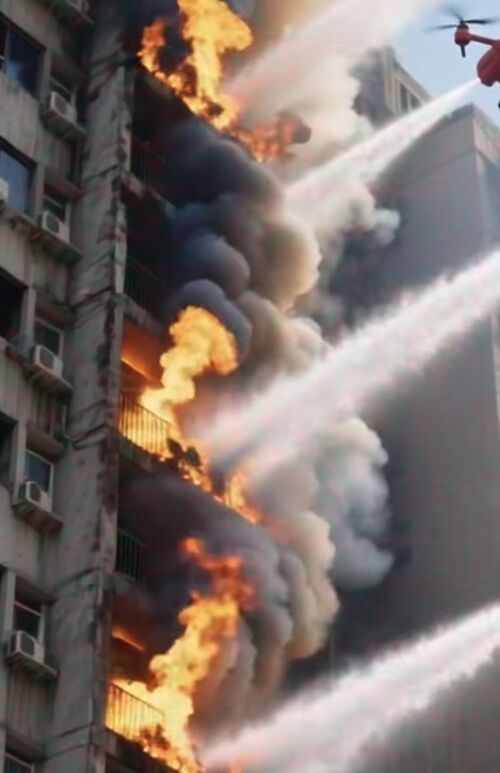
As an innovative technology in the emergency rescue field, UAV firefighting is gradually becoming a mainstay in extinguishing fires in complex scenarios such as high-rise buildings, forest fires, and chemical industrial parks, thanks to its flexibility, efficiency, and safety. Tethering technology, as the core support for UAVs' continuous operations, completely addresses the pain points of traditional UAVs—short battery life, limited payload capacity, and insufficient stability—making high-altitude firefighting more durable and reliable. Below, we answer core questions about UAV firefighting in plain language, integrating the advantages of our tethering technology to break down technical key points, application scenarios, and practical value.
Q1: What are the core advantages of UAV firefighting compared to traditional methods? What key enhancements does tethering technology bring?
UAV firefighting breaks the spatial constraints and safety risks of traditional firefighting, and its core advantages have achieved a qualitative leap with the support of our tethering technology:
Stronger accessibility + continuous operation: UAVs can quickly take off to overcome terrain and height limitations, easily reaching fire points inaccessible to humans. Our tethering system provides stable power/fuel supply from the ground, completely eliminating the constraints of battery life and enabling 24/7 uninterrupted firefighting without the need for mid-mission return.
- Higher safety + stable output: Firefighters can operate remotely without close contact with fire scenes, toxic gases, or explosive risk areas. Our tethered UAVs maintain a more stable flight attitude, and the cables feature wind and torsion resistance, avoiding the crash risk of traditional UAVs caused by insufficient battery life or air current interference.
- Greater efficiency + enhanced payload: Deployment is fast (ready in 5-10 minutes). With our tethering technology, UAVs no longer need to carry heavy batteries, and the saved payload capacity can be used to mount larger fire extinguishing bombs, heavy-duty high-pressure hoses, and other equipment. This allows for precise fire location and continuous suppression, catering to both initial fire control and large-scale fire disposal.
Combined with fire characteristics and the advantages of tethering technology, UAV firefighting has three core operational modes, and our products can accurately adapt to various scenarios:
Single-UAV precision firefighting (adapts to small-scale fires): A single tethered UAV mounts small fire extinguishing bombs or micro high-pressure water guns. For scenarios such as balcony fires in residential buildings or car spontaneous combustion, relying on the continuous power supply of our tethering system, it can hover for a long time to perform precise operations without frequent battery replacement, greatly improving firefighting efficiency.
- Multi-UAV coordinated operation (ensures continuous output): Multiple tethered UAVs form a fleet, dividing tasks such as reconnaissance, firefighting, and warning. Among them, models equipped with our tethering system can serve as "aerial bases," continuously providing firefighting support and real-time data transmission, perfectly adapting to long-duration operation scenarios such as forest fires and large-scale factory fires.
- Air-ground integrated firefighting (core adaptive mode): Tethered UAVs stably mount dedicated fire hoses, connecting to ground pump stations to achieve continuous high-altitude water supply, forming an "aerial water cannon." Our tethering technology ensures that UAVs hover precisely at the designated height for a long time, completely solving the problem of interrupted water supply due to the short battery life of traditional UAVs. It is the optimal solution for scenarios requiring continuous firefighting, such as high-rise buildings and chemical installations.
-
-
A complete UAV firefighting system includes core equipment such as special firefighting UAVs, fire extinguishing payloads, and auxiliary devices, while our tethering equipment is the key to enhancing overall performance:
-
Strong adaptability: Our tethering equipment uses high-strength, lightweight cables with excellent load-bearing capacity that do not affect flight flexibility. It is compatible with mainstream firefighting UAV models at home and abroad, adapting to equipment with different payload requirements ranging from 5 to 50 kilograms.
- Stability and reliability: The tethering system features high-temperature resistance and flame-retardant design, enabling stable operation in complex fire scene environments. Equipped with high-precision hovering algorithms, it can maintain stable attitude in winds above level 6 and heavy smoke, ensuring uninterrupted operations.
- Efficiency and convenience: Adopting a quick-release design, installation and commissioning can be completed within 5 minutes without complex operations. It also supports multiple power supply methods—municipal power, generators, or fuel—adapting to the energy conditions of different rescue sites.
- Payload support: It provides stable high-power supply, capable of driving heavy-duty high-pressure injection modules, multi-channel data transmission equipment, etc., allowing UAVs to carry multiple operational functions simultaneously and improving comprehensive rescue efficiency.
-
-
-
Our tethering equipment accurately solves the three core pain points of UAV firefighting, making operations more efficient and reliable:
-
Unlimited endurance: Traditional UAVs have a battery life of only 30-60 minutes. Our tethering system achieves "zero endurance anxiety" through continuous ground power/fuel supply, fully meeting the needs of long-duration firefighting, warning, and other operations.
- Enhanced payload capacity: Without the need to carry heavy batteries, the saved payload space can be used to increase the capacity of fire extinguishing materials (e.g., 2-3 times more fire extinguishing bombs) or mount heavier firefighting equipment (e.g., large-caliber high-pressure water guns), improving operational efficiency by over 50%.
- Superb stability: The tethering cables have high tensile strength, capable of withstanding air current impacts and torsion. Combined with our independently developed attitude stabilization algorithms, UAVs achieve centimeter-level hovering precision, avoiding fire extinguishing agent waste or water supply interruption caused by shaking.